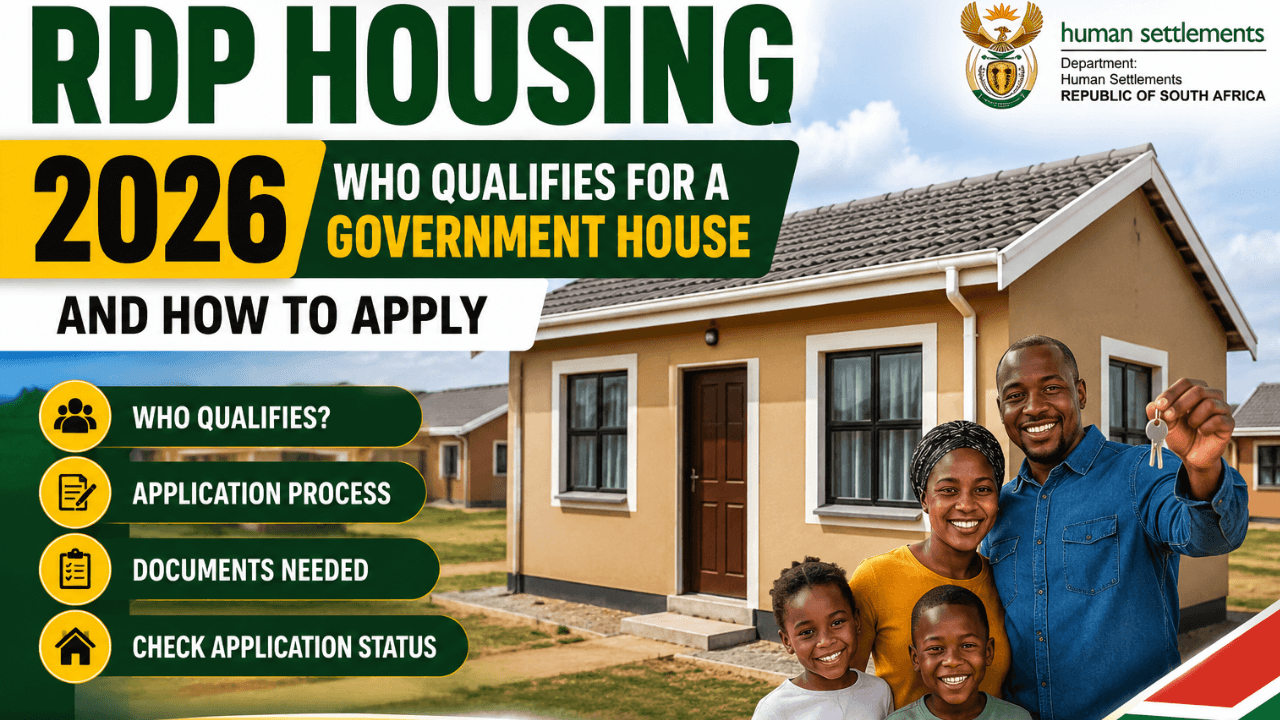
RDP houses remain one of the most sought-after forms of government support in South Africa, but the eligibility rules and application process trip up a lot of applicants. Here’s a clear breakdown of who qualifies, how the process actually works, and what to expect while you wait.
What an RDP house actually is
RDP stands for the Reconstruction and Development Programme, the post-1994 initiative that provides free, government-built homes to South Africa’s lowest-income households. Government now officially calls the programme Breaking New Ground (BNG) or government-subsidised housing, though “RDP” remains the name everyone uses. It is not a loan or a subsidy toward a bond — it’s a fully built home given at no cost to qualifying families, typically a 40–50 square metre freestanding unit with two bedrooms, an open-plan living/kitchen area, a bathroom, and connections for water, electricity, and basic sanitation. The stand and house are transferred into the beneficiary’s name with a title deed, so recipients own the property outright, though they’re still responsible for municipal rates and utilities once they move in.
Who qualifies
To qualify for an RDP house, you generally need to meet all of the following:
- Be a South African citizen with a valid ID (permanent residents may qualify in some cases; temporary residents and asylum seekers do not)
- Be 21 or older and legally competent to sign a contract, with special provision made for child-headed households
- Be married or living with a partner, or be single with dependants — single military veterans and single elderly applicants without dependants also qualify
- Have a total household income of R3,500 or less per month (if multiple household members earn income, their combined earnings must stay under this threshold)
- Be a first-time recipient of a government housing subsidy and a first-time homeowner
- People with disabilities receive preference in allocation, and units are meant to be built or adapted to be accessible
SASSA grant recipients earning below the R3,500 threshold generally fall within the qualifying income bracket automatically.
How to apply
Despite what some websites claim, there is no way to submit a full RDP application online anywhere in South Africa. You must register in person at your local municipal housing office or your provincial Department of Human Settlements office, where an official captures your details into the government’s Housing Subsidy System (HSS). There’s no fee to apply.
Documents you’ll typically need:
- Your ID (and your spouse or partner’s ID, if applicable)
- Certified copies of your children’s birth certificates, if applicable
- Proof of income (such as payslips), or a sworn statement if unemployed
- Proof of address or residence in the municipality, where required
Once captured, your housing need is registered on a national database, and RDP houses are allocated as new housing projects are completed in your area — it’s a waiting list system, not first-come, first-served.
Checking your application status
You can check your status online without submitting a new application — visit the National Housing Needs Register at ndd.co.za and enter your ID number to see where you stand.
How long the wait actually takes
Realistically, waiting lists vary sharply by location. In high-demand provinces like Gauteng and the Western Cape, waits can exceed 10 years, while smaller municipalities may allocate homes within 2 to 5 years. There’s no way to expedite a placement outside of the disability and vulnerability preferences already built into the system.
RDP vs FLISP
If your household earns more than R3,500 a month, you won’t qualify for a free RDP house — but you may still qualify for other support:
| RDP House | FLISP (First Home Finance) | |
|---|---|---|
| What it is | Free, fully built government house | Subsidy toward your own home loan |
| Income range | R3,500 or less per month | R3,501 to R22,000 per month |
| Subsidy amount | House provided at no cost | R27,960 to R130,505 subsidy |
| Ownership | Immediate, via title deed | Via bond, with subsidy reducing what you owe |
| Typical wait | Years (often long waiting lists) | Faster — depends on loan approval, not a waiting list |
| Registration | National Housing Needs Register at your municipal housing office | Same register, different subsidy stream |
You cannot benefit from both programmes, and you won’t qualify for a second government housing subsidy if you already own government-assisted property.
FAQ
Can I apply for an RDP house online?
No. You must register in person at your municipal housing office or provincial Department of Human Settlements office. You can check your existing application status online, but the initial registration has to happen in person.
What’s the income cutoff to qualify?
A total household income of R3,500 or less per month. If more than one person in the household earns income, their combined earnings must stay under that amount.
Is there a fee to apply?
No, RDP applications are free.
How do I check if I’m on the waiting list?
Visit ndd.co.za and enter your ID number to check your status on the National Housing Needs Register.
How long will I wait for a house?
It depends heavily on location — often over a decade in Gauteng or the Western Cape, and anywhere from 2 to 5 years in smaller municipalities.
I earn more than R3,500 a month — do I have any other options?
Yes. If your household income is between R3,501 and R22,000 a month, you may qualify for FLISP (First Home Finance), which subsidises a home loan rather than providing a free house.
Can I get an RDP house if I already own property?
No. You must be a first-time homeowner and a first-time recipient of a government housing subsidy to qualify.
Do people with disabilities get any priority?
Yes. Applicants with disabilities receive preference in allocation, and units are meant to be built or adapted to meet accessibility needs.
The bottom line
Qualifying for an RDP house comes down to income, citizenship, and never having received a government subsidy before — but qualifying is only the first step. Registration has to happen in person at your local housing office, and from there it’s a matter of your name moving up a provincial waiting list as new projects are completed. If your income puts you just above the RDP threshold, FLISP is worth looking into as a faster route to homeownership.