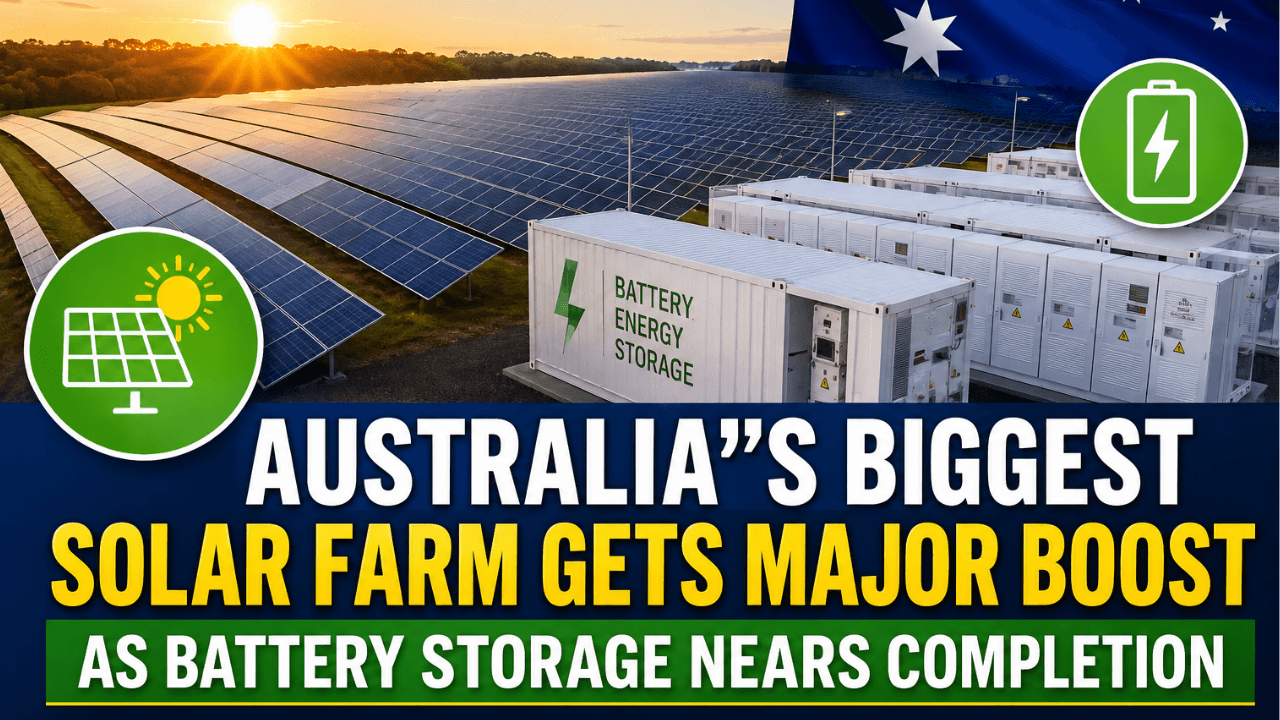
Queensland’s Western Downs Green Power Hub — home to Australia’s largest operating solar farm — has locked in a fresh round of contracts as its battery storage buildout advances, cementing its place as one of the country’s most significant renewable energy projects.
What the project actually is
The Western Downs Green Power Hub, developed by French renewables giant Neoen near Chinchilla in Queensland, pairs a 460 MWp solar farm — currently the largest operating solar farm in Australia, built across more than 1,500 hectares with over one million panels — with an 845 MW / 2,300 MWh battery energy storage system being built in three stages. Together, they form one of the country’s biggest renewable energy hubs, connecting into the grid via Powerlink’s Western Downs substation.
The battery buildout, stage by stage
The battery component is where the recent momentum sits. Stage 1, a 270 MW / 540 MWh installation using Tesla Megapack technology, became operational in mid-2025. Stage 2, an equally sized 270 MW / 540 MWh addition, followed and was completed in September 2025 — reportedly six weeks ahead of schedule. Together, those first two stages already deliver 540 MW / 1,080 MWh of grid-forming battery capacity, making it one of the largest operating batteries with grid-forming inverter technology in Queensland.
Stage 3, a larger 305 MW / 1,220 MWh addition using 312 Tesla Megapack 2XL units and offering four-hour storage duration (compared to two hours for the earlier stages), is currently under construction and expected to become operational in the Australian summer of 2027/28.
The “major boost”: five virtual battery contracts
The project’s latest milestone is commercial rather than physical: Neoen has now locked in five virtual battery agreements for the project, adding new contracts with retailers Nectr and SmartestEnergy to existing deals already in place with AGL Energy, Shell Energy, and Engie. These agreements — essentially long-term contracts where retailers pay to access the battery’s capacity — underpin the project’s revenue and help justify further investment in Australia’s storage buildout. The full battery project carries an estimated cost of around $889 million.
Why it matters for the grid
Grid-forming inverter technology, used across all three battery stages, allows the facility to provide stability services — like frequency control and synthetic inertia — that were historically supplied by fossil fuel power stations. As more coal generation retires from Queensland’s grid, projects like Western Downs are increasingly relied on to keep the system stable, not just to store excess solar energy for use after dark. Once fully built, the combined solar-and-battery hub will support Queensland’s push toward 80% renewable energy by 2035.
What’s operating vs. what’s still under construction
| Component | Status |
|---|---|
| 460 MWp solar farm | Fully operational |
| Battery Stage 1 (270 MW / 540 MWh) | Operational since mid-2025 |
| Battery Stage 2 (270 MW / 540 MWh) | Operational since September 2025 |
| Battery Stage 3 (305 MW / 1,220 MWh) | Under construction, expected operational summer 2027/28 |
| Virtual battery contracts | Five signed — AGL, Shell, Engie, Nectr, SmartestEnergy |
The bottom line
Australia’s biggest solar farm is no longer just a solar story — it’s increasingly a battery story. With two of three planned battery stages already online and five retail contracts now locked in, the Western Downs Green Power Hub is shifting from a generation asset into a firm, dispatchable power source that can support the grid around the clock, with its final and largest battery stage due to complete the picture by the 2027/28 summer.