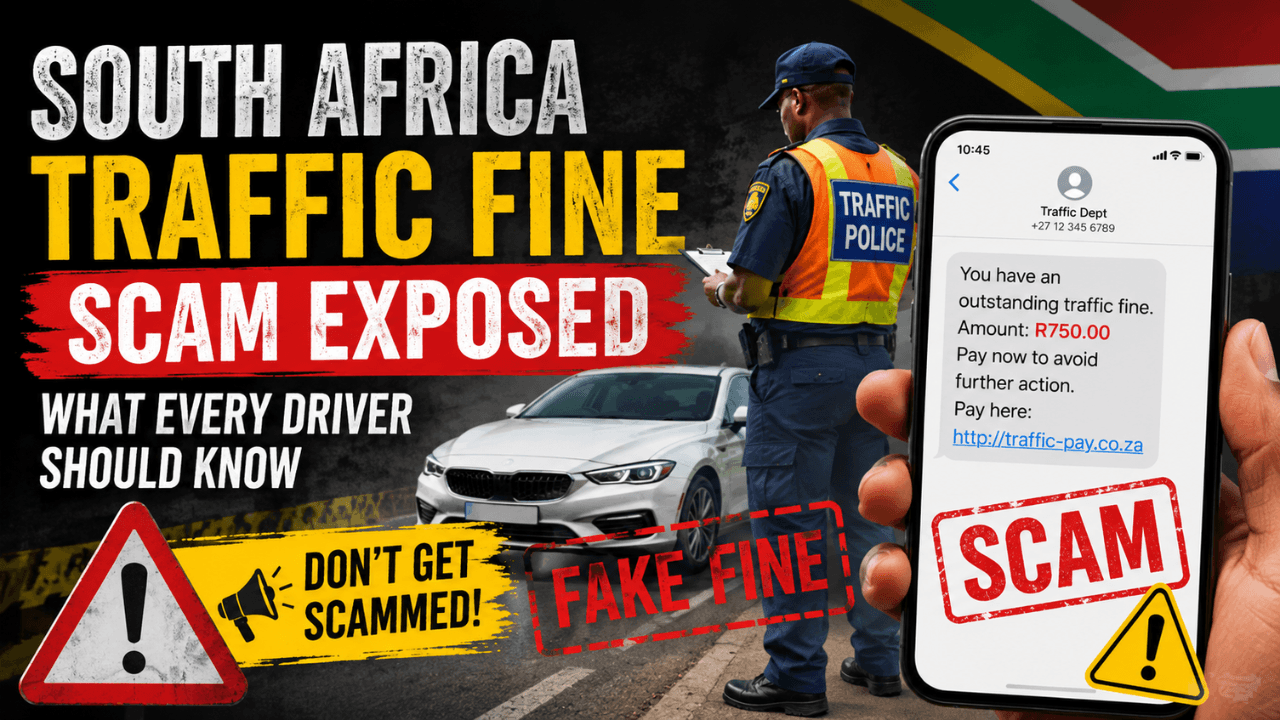
South Africa is seeing a sharp rise in fake traffic fine messages, and both police and consumer watchdogs say the scam has grown more dangerous than a simple attempt to collect a small payment. Here’s what’s driving it, how it works, and how to protect yourself.
Why the scam is spreading now
The surge is tied directly to confusion around the rollout of the Administrative Adjudication of Road Traffic Offences (AARTO) system, which is changing how fines are issued and enforced nationwide. Fines SA has warned that fraudsters are deliberately exploiting public uncertainty and urgency around AARTO’s phased rollout to push fake “ghost fine” payments. The rollout has also been repeatedly delayed and rescheduled — most recently pushed to 1 July 2026 — which has only added to public confusion that scammers are cashing in on. The next major milestone, a demerit points system tied to fines, is due in September 2026, and Fines SA warns the risk will intensify once it takes effect.
How the scam typically works
Victims usually receive an unsolicited SMS, email, or WhatsApp message claiming they have an outstanding fine, often with threatening language about licence suspension, mounting penalties, or legal action if they don’t pay immediately. The messages include a “pay now” link to a cloned website designed to look like an official government or municipal payment portal. Some scam emails have carried a subject line claiming urgent action is needed to avoid extra penalties, listing a fake outstanding balance that grows the longer the recipient waits. Many victims report being billed for vehicles they don’t own or offences in places they’ve never been.
It’s not just about losing a few hundred rand
A News24 report citing a fraud expert warns the scam can be far more damaging than the fine amount itself: entering your card or banking details on a cloned payment page can let criminals harvest your full account information, opening the door to further fraud well beyond the initial transaction. SAPS has echoed this, saying scammers direct victims to fake payment portals specifically to steal personal and banking data, not just to collect a one-off fee.
Who’s warning drivers
- SAPS has issued a public alert about criminals posing as traffic authorities — including the National Traffic Information System (NaTIS) and municipal traffic services — via email, SMS, and phone calls.
- The Road Traffic Infringement Agency (RTIA) has confirmed that fake AARTO notices circulating by email are fraudulent, and stressed that the only official AARTO website is aarto.gov.za. It says AARTO infringements are currently only served in person or by registered mail — never by SMS or unsolicited email.
- OUTA (Organisation Undoing Tax Abuse) has urged motorists to learn to tell scams apart from legitimate notices, while cautioning that scam warnings are not an excuse to ignore genuine fines.
Red flags to watch for
- An unexpected SMS, email, or WhatsApp about a fine you weren’t already aware of
- A link urging you to “pay immediately” to avoid extra penalties
- Urgent, threatening, or countdown-style language
- Messages from unfamiliar senders or addresses that only loosely resemble official ones
- Requests for payment or personal/banking details on a site you didn’t navigate to yourself
Scam vs. legitimate: quick comparison
| Fake traffic fine | Legitimate AARTO notice | |
|---|---|---|
| How it arrives | Unsolicited SMS, email, or WhatsApp | In person or by registered mail |
| Tone | Urgent, threatening, countdown to “avoid extra penalties” | Formal, no artificial urgency |
| Website | Cloned page mimicking a government or municipal portal | aarto.gov.za only |
| Payment request | Immediate payment via embedded link | Verified through official or accredited platforms |
| Details asked for | Often full card/banking details on the linked page | Standard payment details on a verified platform, at your initiative |
| Timing | Frequently sent after hours or on weekends | Sent through standard administrative channels |
| Vehicle/offence match | Sometimes for a vehicle you don’t own or an offence you weren’t near | Matches your actual vehicle and infringement record |
FAQ
Is AARTO fully rolled out across South Africa yet?
No. The rollout has been repeatedly delayed and pushed back, most recently to 1 July 2026, with the demerit points system only due from September 2026. Scammers are exploiting the resulting public confusion.
What is the only official AARTO website?
aarto.gov.za. RTIA has confirmed that any other site claiming to be the official AARTO portal is not legitimate.
Can I get a real traffic fine by SMS?
Fines SA says it never sends fines via SMS, and RTIA says AARTO infringements are currently only served in person or by registered mail — not by text message.
I clicked a link and entered my card details. What should I do?
Contact your bank immediately to flag possible fraud and monitor your account, then report the incident to SAPS. Experts warn that scam fine sites are often designed to harvest full banking details, not just collect a one-off payment.
Does ignoring these warnings mean I can ignore fines altogether?
No. OUTA has cautioned that scam warnings don’t excuse ignoring genuine fines — the goal is to verify independently before paying, not to dismiss every notice you receive.
How can I check if a fine is real?
Go directly to an official or accredited platform yourself rather than using any link sent to you, and verify the fine through that channel before paying anything.
Who do I report a suspected scam to?
SAPS asks anyone who receives a suspicious message to avoid paying or clicking links, and to report it to the South African Police Service.
How to protect yourself
- Don’t click links in unsolicited messages. Go directly to a known official platform instead.
- Verify before you pay. Check the fine independently through an official or accredited platform rather than the one named in the message.
- Know the real AARTO channel. The only legitimate AARTO site is aarto.gov.za — anything else claiming to be AARTO should be treated as suspicious.
- Remember how real notices are served. Legitimate AARTO infringements are currently delivered in person or by registered mail, not by SMS.
- Watch for after-hours messages. Many fraudulent emails are sent outside business hours, especially on weekends, when victims are less likely to double-check with an official source.
- Report suspicious messages. SAPS advises against making any payment or clicking embedded links, and recommends reporting the incident to police.
- Don’t use the scam warnings as an excuse to ignore all fines. Genuine traffic fines still need to be paid — the safest approach is independent verification, not blanket dismissal.
The bottom line
As AARTO’s rollout continues through 2026, expect scammers to keep exploiting the confusion around it. The safest habit for any South African driver is simple: never act on urgency baked into an unsolicited message. Verify any claimed fine through an official government channel or an accredited platform before entering any payment or personal details.